System Catalog
Precision-Engineered Architectural Assemblies & Glazed Modules
Explore commercial and high-end residential fenestration systems manufactured under stringent AS 2047, NFRC, CE, and ISO 9001 protocols for high wind load, corrosion resistance, and verified thermal performance.
Manufacturing Rigor
180,000 m² Base: Tier-1 Production Infrastructure
Operating as Guangdong Dejiyoupin Doors and Windows Co., Ltd. (DERCHI), our centralized smart manufacturing hub de-risks multi-container, cross-border commercial and institutional projects.
180,000 m²
Foshan Manufacturing Footprint
1,000,000+ m²
Annual Dynamic Finished Capacity
100+ Patents
Proprietary Locking & Profiles
600+ Staff
30+ Senior Structural Engineers
Invention Patent: 4-Side 6-Point Lock
Traditional aluminum screen and net doors depend on single perimeter latch points susceptible to crowbar leverage. Our patented mechanical gear drives stainless tongue pins outward across four frame perimeters simultaneously, establishing tamper-proof structural rigidity.
360° Intelligent CNC Fabrication
Extrusions (6063-T5 / 6063-T6) pass through multi-axis automated German milling centers. Milling tolerance limits stay under ±0.3mm across mitered corner joints, eliminating water creeping paths and ensuring flawless alignment of woven 316 wire screens.
Global Engineering Compliance
Factory-direct test certificates available per batch: Australian Standard AS 2047 & AS 1288, North American NFRC/CSA thermal and structural ratings, CE marking (EN 14351-1), Hurricane Impact testing, and ISO 9001 quality management oversight.
Procurement Intelligence
Macro Trends & Technical Trajectories in Aluminum Net Doors
Strategic purchasing guidelines for developers, facade consultants, and general contractors navigating heightened sustainability targets and structural security requirements.
Thermally Broken Security Screens
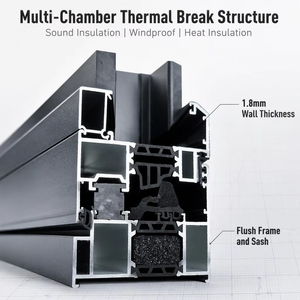
Historical net and mesh screens functioned strictly as physical barriers with no thermal isolation. Future specifications demand polymide thermal-break barriers (PA66 GF25) within the outer net sub-frame to avoid cold bridging when paired with Passive House glass assemblies.
- Prevents condensation along interior screen frame
- Enables compliant U-values under NCC 2022 / NZBC H1
- Maintains flush architectural thresholds
0.9mm Marine-Grade 316 Woven Core
Procurement is moving away from cheap 304 or fiberglass screening toward 0.8mm–1.0mm high-tensile 316 marine-grade stainless steel woven meshes. In coastal environments, chemical anodizing combined with AkzoNobel fluorocarbon powder coatings stops galvanic pitting.
- Knife shear resistance under AS 5039 / AS 5041
- Over 3,000 hours neutral salt spray rating (ASTM B117)
- Integrated pressure clamp retention strips
Smart Access & Concealed Automation
Architectural buyers increasingly reject bulky face-mounted hardware. Next-generation custom OEM net doors integrate hidden motor drives, flush magnetic contact switches, and biometric handles that communicate with building access control ecosystems.
- Hidden concealed hydraulic soft-close damping
- Concealed multi-point lock mortises
- Flush sill transitions compliant with ADA standards
| Evaluation Parameter | Standard Market Net Doors | DERCHI Custom OEM Heavy-Duty System | Engineering Compliance Target |
|---|---|---|---|
| Alloy Metallurgy | Recycled aluminum scraps / mixed 6063 | 100% Virgin 6063-T5 or T6 Architectural Billet | Tensile strength ≥ 205 MPa; Web thickness ≥ 2.0mm |
| Security Mesh Integrity | 0.5mm 201/304 wire mesh; bonded with mastic | 0.9mm 316 Marine-grade stainless; clamped via bolted alloy jaws | Dynamic Impact AS 5041 & Anti-Jemmy Test Passed |
| Locking Multi-Point Drive | Single deadbolt or 2-point hook latch | Patented 4-Side 6-Point Gear Transmission Rods | Forced Entry Prevention (Grade 40 Certified) |
| Weather Seal Protection | Standard foam tape / discontinuous pile | Co-extruded continuous EPDM vulcanized gaskets | Water tightness ≥ 450 Pa; Air infiltration Class 4 |
| Finish Durability | Standard industrial polyester powder coating | AkzoNobel Interpon D2525 / Qualicoat Class 2 certified | AAMA 2604 / AAMA 2605 compliant (10-25 yr lifespan) |
Direct Answers
Frequently Asked Questions: Global OEM Door Sourcing
Essential technical clarifications addressing structural certification, packaging protocols, supply chain logistics, and production customisation.
What structural and impact certifications back DERCHI aluminum net and glass doors?
Our systems are certified according to primary international codes. In Oceania, our windows and screen doors hold full Australian Standard AS 2047 certification with glass matched strictly under AS 1288. For the North American market, our systems carry NFRC and CSA certification with approved thermal transmission and air/water infiltration data. Furthermore, our products carry CE marking (EN 14351-1), Hurricane-resistant impact certifications, and are fabricated inside an ISO 9001:2015 verified operating environment. Batch-specific mill test certificates (MTC) and factory test reports accompany all commercial export manifests.
How does the proprietary Four-Side Six-Point locking invention patent operate?
Unlike conventional net doors that lock only on the strike jamb, our patented invention uses internal drive bars located inside the extruded perimeter profiles. When the primary handle is actuated, transmission gears simultaneously push hardened anti-saw stainless steel pins across the top rail, bottom sill, strike jamb, and hinge perimeter. This immobilizes the door leaf against prying tools, distributing structural deflection across the entire sub-frame under wind loads and forced-entry attempts.
Can frames be customized for extreme marine and tropical cyclonic climates?
Yes. For coastal properties subject to harsh salt spray, we apply Qualicoat Class 2 marine-grade powder coatings (minimum thickness 60–80 microns) or deep acid-etch anodizing exceeding 25 microns. All woven netting is upgraded to AISI 316 marine-grade stainless wire with an acrylic electro-deposition coating to eliminate galvanic contact corrosion. For high wind and hurricane zones, profiles utilize internal reinforcement sleeves engineered to withstand positive and negative design pressures upwards of 4500 Pa.
What are the ocean freight lead times and packaging safety measures?
All doors receive full peelable protective surface film, rigid corner guards, and multi-layer bubble wrapping before being loaded into fumigated solid-plywood export crates fitted with internal desiccants. Crates are loaded via overhead hoists to avoid container handling damage. Typical port-to-port ocean transit from our South China hub ranges from 13 to 18 days for Eastern Australia (Sydney, Brisbane), 16 to 22 days for New Zealand (Auckland), and 15 to 25 days for US West Coast and European base ports.
What is the standard OEM/ODM design confirmation workflow?
Our technical engineering team works directly off your architectural elevation drawings or window schedules. We supply complete shop drawings (including profile sections, anchoring details, glass schedules, and sill integration) within 48 to 72 hours. Once finishes, hardware, and shop drawings are signed off, rapid physical corner samples or functional prototypes can be produced before batch production begins on dedicated production lines.
Request Detailed Shop Drawings & Project Quotes
Collaborate directly with our engineering division for custom profile development, hurricane impact configurations, or container-load OEM pricing.