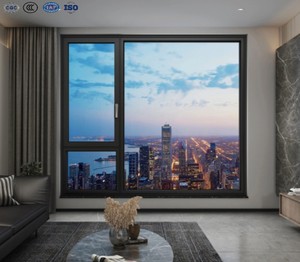
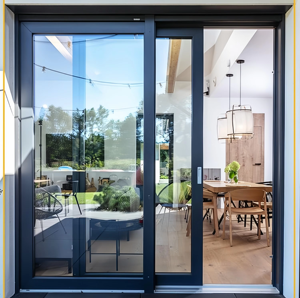
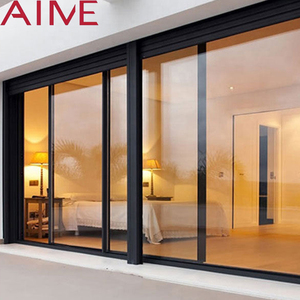
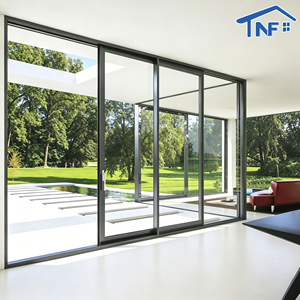
Custom OEM Aluminium Doors And Windows Manufacturers & Exporter
Engineering-led fenestration solutions certified to AS 2047, CE, NFRC, and CSA standards. Direct-from-factory manufacturing powering residential, commercial, and luxury infrastructure worldwide.
Precision Fenestration Systems
Engineered Product Portfolios for Global Developments
Explore our certified architectural product line designed for extreme structural wind loads, high thermal barrier performance, and seamless indoor-outdoor transitions. Manufactured with certified 6063-T5/T6 structural aluminium extrusions and factory-sealed insulated glass units (IGU).
Enterprise Advantage: Engineering-Grade Manufacturing & Global Quality Governance
In international fenestration sourcing, commercial developers, quantity surveyors, and facade engineers face a critical dilemma: balancing high architectural aesthetics with rigid thermal, water resistance, and acoustic standards. Guangdong Dejiyoupin Doors and Windows Co., Ltd. (DERCHI) operates as an elite-tier manufacturing engine across a modern 180,000 m² smart industrial footprint located in Foshan, China. Driven by a dedicated engineering squad of over 30 R&D structural specialists and 600+ master fabricators, we produce in excess of 1,000,000 m² of certified aluminium windows, architectural doors, curtain walls, and winter sunroom enclosures annually.
Recognized by official international testing authorities and validated under the Xinhua News Agency "China Famous Brand" framework, our engineering discipline is built on zero-tolerance tolerance thresholds. Every extrusion profile utilizes primary billet alloy 6063-T5 or 6063-T6 architectural aluminium, completely eschewing post-consumer unrefined scrap to prevent microscopic structural inclusions and localized pitting corrosion. Combined with our patented hardware systems—such as our proprietary Four-Side Six-Point Perimeter Multi-Locking System—our units deliver unprecedented burglary resistance, cyclone perimeter structural integrity, and long-term dimensional stability in rigorous coastal marine environments.
Full Accreditation Grand Slam
Multinational Certification Compliance
We operate an accredited in-house testing laboratory cross-referenced with global building certifiers. Our products hold authentic test reports and compliance passes for Australian Standard AS 2047 (Windows in buildings), AS 1288 (Glass in buildings safety glazing), CE EN 14351-1 (European CE marking), NFRC (North American energy rating), CSA (Canadian Standards Association), and ISO 9001 environmental and quality management regimes.
Surface Science
Qualicoat Class 2 & Fluorocarbon Finishing
For oceanic, tropical, and sub-zero installations, standard finishes degrade rapidly. DERCHI applies AkzoNobel and PPG architectural coatings via high-automation horizontal electrostatic lines. Options include Qualicoat Class 2 ultra-durable powders, 25-micron architectural anodizing (AAMA 611 compliant), and PVDF fluorocarbon coatings certified to pass 4,000+ hours of neutral salt spray (ASTM B117) without micro-blistering or chalking.
Smart OEM / ODM Integration
Bespoke Structural Extrusions & Hardware
Beyond catalogue solutions, our engineering desk collaborates directly with architects and developer procurement leads. We execute customized die extrusions, thermal strip configurations (Technoform PA66GF25), concealed heavy-weight hinge integration (supporting single sash weights exceeding 400kg for motorized patio systems), and structural silicone glazing (SSG) curtain wall modules tailored to unique site wind pressures.
Procurement Intelligence
The Strategic Guide to Sourcing Custom OEM Aluminium Openings
A deep architectural analysis of engineering factors, thermal physics, structural integrity, and international logistics criteria necessary for mitigating commercial procurement risk.
1. Thermal Barrier Physics: Polyamide Struts (PA66GF25) vs. Pour-and-Debridge Systems
When evaluating high-performance aluminium windows for energy-efficient building standards (such as Australia's National Construction Code NCC 2022 Section J, New Zealand's NZBC H1, or European Passive House metrics), the design of the thermal break is paramount. Traditional aluminium profiles conduct heat rapidly (thermal conductivity $\lambda \approx 160\text{ W/m}\cdot\text{K}$). Modern architectural OEM fabrication requires the insertion of structural thermal barrier strips.
We utilize Polyamide 6.6 reinforced with 25% glass fiber (PA66GF25), possessing a thermal conductivity of approximately $0.3\text{ W/m}\cdot\text{K}$. The glass fiber reinforcement matches the coefficient of thermal expansion of aluminium ($2.3 \times 10^{-5}\text{ K}^{-1}$), ensuring that during cyclical temperature extremes (-30°C to +80°C surface temperatures), the profile maintains composite mechanical integrity without shear failure or internal gas seal breach. Combined with multi-cavity chamber designs and low-density foam inserts, whole-window U-factors can be driven below $1.3\text{ W/m}²\cdot\text{K}$ ($U_w$).
2. Glazing Technology: Acoustic Attenuation and Low-E Solar Control
An aluminium frame is only as robust as its glass envelope. Professional project bidding demands meticulous optimization of the Insulated Glass Unit (IGU). In high-noise urban or flight-path zones, single-thickness symmetric double glazing (e.g., 6mm + 12A + 6mm) suffers from coincidence frequency dropouts where sound waves vibrate through the glass pane simultaneously. DERCHI engineers asymmetric configurations (e.g., 6mm toughened outer + 16A Argon warm-edge spacer + 8.38mm PVB laminated inner), which disrupts the acoustic vibration resonance and delivers sound transmission class ratings of STC 38dB to STC 44dB.
For solar control, our magnetron sputtering offline Low-E glass (double or triple silver Low-E coatings) accurately modulates the Solar Heat Gain Coefficient (SHGC) between 0.22 and 0.45 while retaining high visible light transmittance (VLT > 65%), vastly trimming mechanical HVAC lifecycle costs for commercial operators.
System Classification
Structural Wind Pressure
Water Penetration Limit
Acoustic Rating (STC/Rw)
Thermal Transmittance (Uw)
Primary Target Compliance
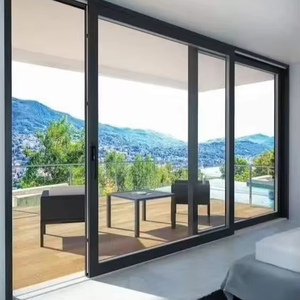
AS 2047 Extreme Sliding System
Serviceability: 2500Pa Ultimate: 4500Pa+
600Pa to 1000Pa
STC 39 - 42 dB
1.4 - 1.8 W/m²·K
Australia AS 2047 / AS 4055 (N1-N6, C1-C4)
Commercial Heavy-Duty Lift & Slide
Serviceability: 3000Pa Ultimate: 5000Pa
750Pa
STC 38 - 43 dB
1.3 - 1.7 W/m²·K
North America ASTM E283/E330/E331, AAMA
Passive-Line Architectural Casement
Serviceability: 3500Pa Ultimate: 6000Pa
1050Pa
STC 40 - 45 dB
0.85 - 1.2 W/m²·K
Europe CE EN 14351-1 / Passive House Req.
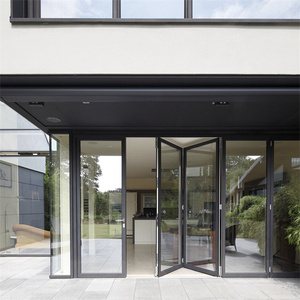
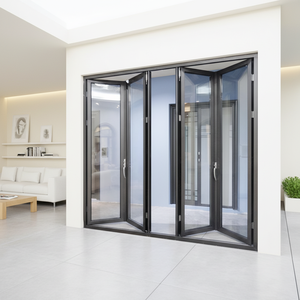
Cyclone-Shield Impact Bifold Door
Serviceability: 3200Pa Ultimate: 5500Pa+
600Pa
STC 37 - 41 dB
1.5 - 1.9 W/m²·K
Pacific Island High Wind & Hurricane Zones
Market Horizon 2025–2030
Product Development & Global Procurement Trends
Anticipate shifts in global supply chain legislation, environmental certifications, and smart fenestration integration to keep your development portfolio ahead of regulatory shifts.
Decarbonization Mandate
Low-Carbon Circular Aluminium Sourcing
Institutional developers are enforcing strict embodied carbon thresholds across architectural envelopes. The future of OEM sourcing hinges on hydro-powered low-carbon primary aluminium billets with documented Environmental Product Declarations (EPD). DERCHI has engineered supply agreements ensuring smelting emissions remain under 4.0 kg CO2e per kg of aluminium, aiding builders in securing LEED Platinum, BREEAM Outstanding, and Green Star credits.
BMS Integration
Mechatronic & Smart Building Automation
Manual operation is increasingly giving way to architectural smart integration. OEM procurement contracts now routinely request concealed 24V DC brushless motor actuators, magnetic contactless safety sensors, micro-ventilation climate feedback louvers, and smart tint electrochromic glazing. Systems integrate natively with KNX, BACnet, and Zigbee automation protocols to self-regulate interior air cycles and shading.
Design Optimization
Ultra-Narrow Visual Sightlines & Flush Tracks
High-end architectural developments are abandoning bulky 120mm face-width profiles in favor of ultra-minimalist interlocks ranging between 18mm and 26mm. This aesthetic must be engineered without sacrificing wind load capacity. We achieve this through carbon-fiber composite internal structural stiffeners and zero-threshold concealed drain pans that sit completely flush with interior timber flooring and exterior decking.
Precision Execution Workflow
The 8-Stage OEM/ODM Engineering Protocol
A documented, transparent manufacturing lifecycle engineered specifically for cross-border developer security, guaranteeing exact dimensional tolerances before container dispatch.
01
CAD & BIM Analysis
Thorough verification of project architectural schedules, structural wind loads, and opening tolerances.
02
Extrusion Engineering
Custom structural die cutting, thermal strut crimping, and computerized CNC profile fabrication.
03
Surface Treatment
Automated pretreatment, electrostatic powder coating or anodizing adhering strictly to Qualicoat Class 2.
04
Robotic IGU Assembly
Automated insulated glass unit sealing with warm-edge spacers, 95%+ Argon gas infill, and Low-E QA.
05
Hardware Integration
Installation of multi-point German-engineered gearboxes, concealed heavy-duty hinges, and EPDM dual gaskets.
06
360° Trial Assembly
100% full-frame pre-assembly in the factory to ensure 0-defect diagonal squaring and seamless sash travel.
07
Export-Grade Packing
Protective PE peelable films, high-density shock-absorbing corner buffers, and fully enclosed IPPC steel-banded crates.
08
On-Site Guidance
Provision of comprehensive BIM installation details, direct engineer video link-ups, and field support teams.
Procurement Clarification
Frequently Asked Questions for Commercial Buyers
Authoritative guidance on testing protocols, compliance verification, lead times, export logistics, and OEM factory collaboration.
Are DERCHI aluminium windows and doors fully certified to Australian Standard AS 2047?
Yes. Our core residential and commercial window and door systems possess official AS 2047 physical test reports issued through NATA-accredited test laboratories. Test certifications cover positive and negative deflection wind pressure tests (AS 4055), operating force checks, air infiltration limits, water penetration resistance (up to 600Pa - 1000Pa depending on sub-sill drainage configuration), and ultimate structural strength testing up to 4500Pa+. Fully validated shop drawings and compliance test certificates are supplied directly for submission to private building certifiers and municipal councils across all Australian states.
How does DERCHI ensure structural compliance in cyclonic and high-wind zones?
For cyclonic destinations (such as Australia Wind Region C and D, the South Pacific, or Florida HVHZ zones), we integrate reinforced mullion sections engineered with higher moments of inertia (Ix value), custom structural steel core sleeves, and SentryGlas (SGP) or high-impact PVB laminated glass layups. Combined with our heavy-duty four-side multi-point locking system, our cyclone-rated assemblies withstand cyclic wind pressures and large missile debris impacts without frame pop-out or water breach.
Can you customize profiles and hardware according to our private label or architectural drawings?
Yes. As a pure OEM/ODM manufacturer, we develop custom aluminium extrusion tooling, die sets, and specialized hardware molds based on client CAD or Revit specifications. We can apply laser-engraved private logos, custom RAL architectural powder-coat finishes, specialized perimeter sub-head and sub-sill flashings, and bespoke timber-aluminium hybrid profiles for residential brands, building material importers, and commercial developers worldwide.
What are the typical manufacturing lead times and ocean shipping timelines?
Standard fabrication lead time is 25 to 35 working days following signed shop drawing approval and color swatch confirmation. For high-volume multi-container developments (e.g., 50+ containers), shipments can be rolled out in staged sequences to accommodate construction schedules. Port-to-port ocean transit from South China ports (Nansha/Shekou/Yantian) is approximately 14–18 days to Sydney/Melbourne, 16–22 days to Auckland, 20–25 days to West Coast USA, and 28–35 days to European main ports.
How are glass units and frames protected against transit damage and ocean humidity?
All manufactured frames are protected with UV-resistant peelable surface tape. Corner profiles receive rigid molded plastic guards. Glass panes feature anti-scratch separating cork pads. Assemblies are subsequently vacuum-wrapped in moisture-barrier film and packed into heavy-duty fumigated plywood crates (ISPM 15 compliant) with internal steel reinforcement bands, preventing glass shock vibration, humidity corrosion, or racking during container loading and crane transfer.
How does DERCHI assist international contractors with site measurement and installation?
Every custom export consignment is accompanied by comprehensive 3D shop drawings, cross-sectional connection details, and step-by-step installation guides. We detail sub-frame anchoring, flashing drainage paths, membrane sealing interfaces, and gasket expansions. For landmark commercial undertakings, our structural facade engineers provide direct real-time video conference supervision, or can dispatch on-site technical advisors to train local contracting crews.
Accelerate Your Next Architectural Fenestration Tender
Connect directly with our senior facade engineering desk. Send your window schedules, architectural blueprints, or tender specifications for a free thermal and structural compliance audit, factory cost estimate, and comprehensive OEM proposal.